


LifeLine Champions, LLC
Carrier Screens
Genetic Carrier Testing
Every person carries two copies of most genes—one from each parent. Also known as a hereditary carrier or carrier, a genetic carrier is an individual who has a mutation in one copy of a gene. While, as a carrier, the person doesn’t have the disease associated with the mutation, he or she may pass this mutation on to his or her children, as a carrier has a 50% chance of passing the same mutation to the child.
.jpg)
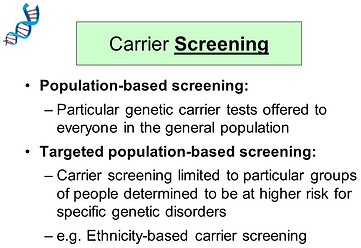


For soon-to-be parents, this can be worrisome because a carrier doesn’t necessarily know if he or she carries a genetic condition, as there may be no symptoms of the disease. However, if both parents discovered they were carriers for the same genetic disease, their child would have a 25% chance of inheriting both copies of the mutation, then leading to the development of the genetic disease.
Today, all potential fathers and women who have a desire to give birth should be screened for more than 120 recessive genetic diseases and receive a complete blood count to screen for a number of genetic disorders, some of the more common genetic diseases include:
· Down Syndrome
· Sickle Cell Anemia
· Cystic Fibrosis
· Hemophilia
· Down Syndrome
· Marfan Syndrome
· Duchenne Muscular Dystrophy
· Spinal Muscular Atrophy
· Fragile X Syndrome
· Tay-Sachs Disease


Genetic carrier screening is a test to determine if an individual is a carrier for certain genetic diseases. Through a blood or saliva sample, a lab can check for genetic mutations associated with diseases and conditions. While DNA testing can provide insight into your health history, it’s not 100% foolproof. There’s always a small chance that one can test negative but actually be a carrier.